Finance App
Bringing years of personal finances together into an app I can actually keep up to date.
I've been keeping track of my personal finances in spreadsheets for years. With accounts in the UK and Spain, transactions in pounds and euros, and my freelance income to consider, it had become quite a complicated job. I had an Excel ledger, dashboards I'd generated from it and a separate Notion tracker for account balances, but keeping everything up to date meant repeatedly downloading statements, categorising transactions and checking the figures.
I'd tried using AI to make this easier, including experiments with processing bank statements and generating reports. Some of it worked surprisingly well, but I kept running into the same problem of getting AI to classify a transaction is easy enough, but knowing whether it's right, correcting it and making sure it stays corrected the next month is another matter.
After several attempts at improving the spreadsheets and reporting, I started wondering whether I could build a small application around the whole process instead. The idea wasn't to create another accounting package. I wanted something that could take the financial information I already had, help me keep it up to date and answer the questions I actually ask about my money.
Product screens and details


Overview
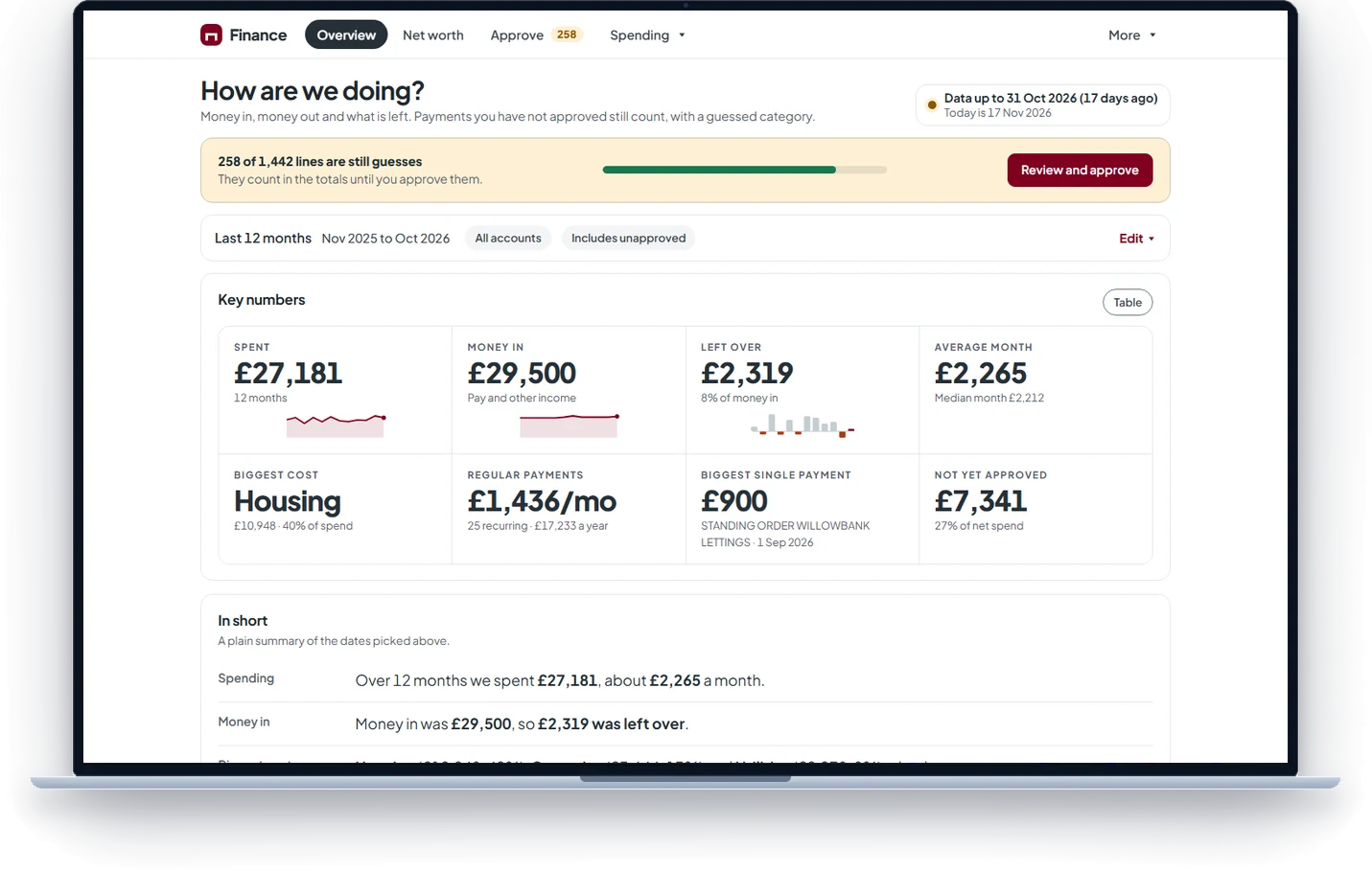
How are we doing? The last twelve months of spending and income, with a clear count of lines that are still guesses.
Approve
Categories stay provisional until they are approved. Clear groups of merchants can be approved together, and every rule is saved for next month.
Net worth
All account balances at each month end, added up, with the change over the last month and the last year.
Dashboard
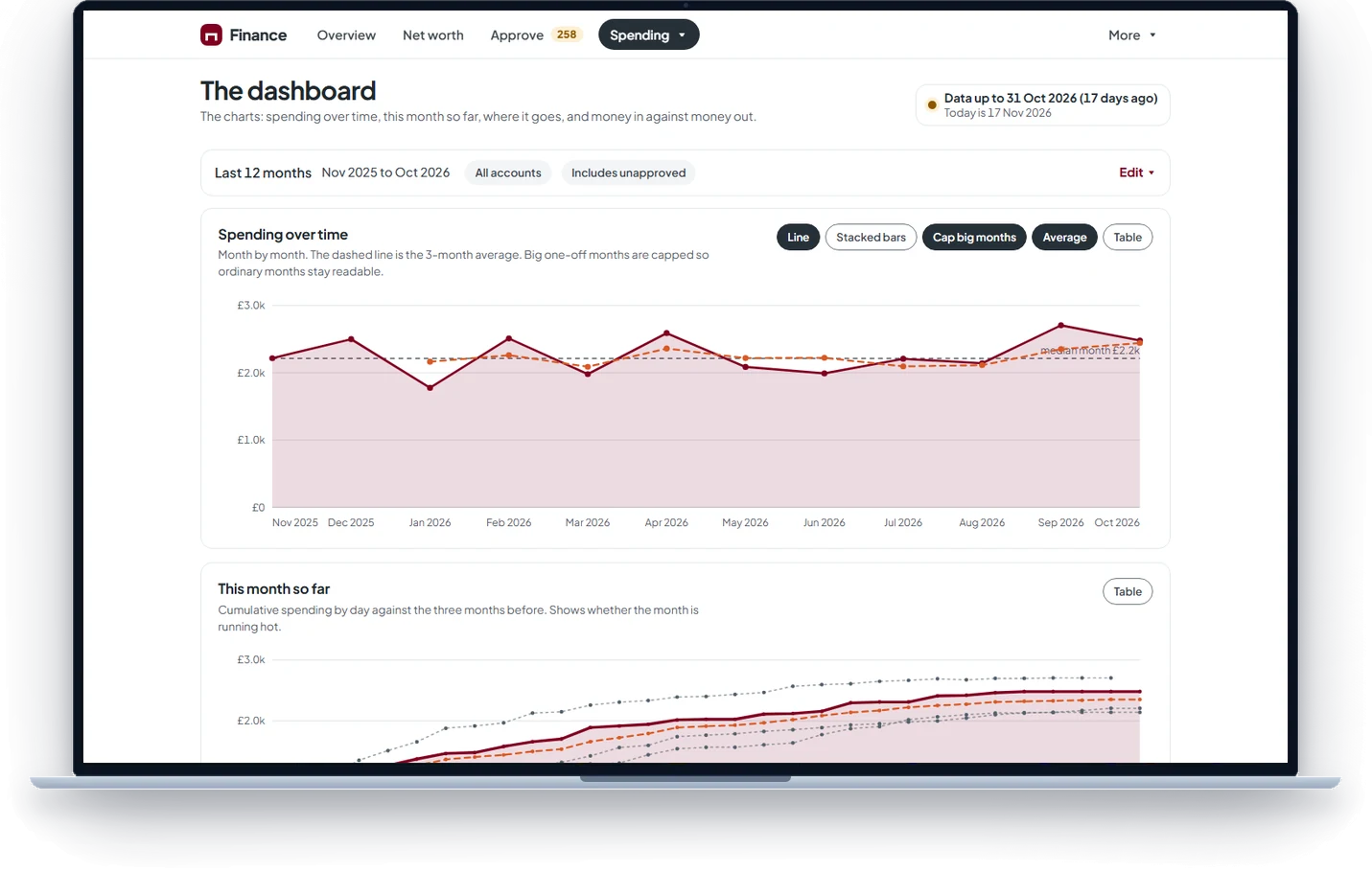
Spending over time, where it goes and money in against money out, with a three-month average to show whether a month is running hot.
Select a screen to enlarge it. The screens come from the demo and show made-up sample data.
The story behind the project
The product
Finance App is a private website that brings together my bank transactions, spending, balances and earnings so I can see where my money goes and how my finances are changing. It started with the information I'd already collected in Excel and Notion, but I'm gradually replacing the manual monthly process with something I can manage in one place.
The main workflow is importing statements and reviewing the transactions. I can give a bank statement to Claude in a chat, and a custom MCP connector allows it to add the transactions to my private database. The app categorises what it can, groups transactions by merchant and shows anything that still needs a decision. I can approve the suggestions, correct them and save merchant rules for future imports. It also handles transactions in euros and reports them in pounds, keeping the original amounts and conversion information.
Beyond that I've been building out dashboards for spending, patterns and account balances, along with a net-worth view. More recently I've added areas for freelance income, invoices, earnings across different tax years and financial projections. The scope has expanded as I've started using the app and realised which information I'd like to see together. The charts and sparklines are drawn with Product Scope Charts, my free, open-source set of hand-built SVG charts.
It's hosted privately on Cloudflare, with the transactions stored in a D1 database. There are no automatic connections to my banks: I decide which statements to provide. I also keep the real financial data out of the GitHub repository. To show how the application works without exposing any of my personal finances, there's a limited demo that uses made-up sample data.
Building it with AI
The project has gone through several versions. I started with a fairly substantial Excel ledger and used AI to help classify transactions and generate summaries. I also kept monthly balances in Notion and tried different ways of getting the information into something more useful. Each experiment solved part of the problem, but none really removed the need to go back over spreadsheets and check everything again.
The turning point was deciding that the data needed a proper home and that I needed a way to review it. With Claude Code I built a private application around Cloudflare D1, using Python scripts to bring in the historical ledger. Importing it wasn't completely straightforward. There were inconsistent signs between bank and card accounts, dates that needed correcting and euro transactions where the original amount or exchange rate wasn't properly recorded. Those issues needed sorting out before I could trust the dashboards.
I also wanted to be able to work with my finances through Claude rather than manually entering every transaction. I built a custom MCP connector so I could supply statements in a conversation and have the assistant prepare the entries. But I didn't want an AI guess becoming an accepted financial record just because it sounded plausible. The app distinguishes provisional categories from ones I've approved, and assistant changes are logged. If a merchant is ambiguous or a transaction looks like a transfer or refund, it needs reviewing rather than silently being treated as spending.
Once the basic ledger and approval process were working, I started adding the reports I'd wanted from the outset. That led to a lot of changes to the interface, categories, tags and dashboards, and more recently to earnings and net-worth information. I've been building it in stages, making changes as I see what is missing or awkward to use, rather than starting with a complete finance-system specification.
I've also had to take the security side more seriously than with some of my other personal AI projects. It's a private application containing sensitive information, so it has authentication, controls around what the Claude connector can change, audit records and a separate backup process. The code can be kept in GitHub without putting bank statements or financial records there.
Results and reflections
Finance App is working privately, but I wouldn't call it finished. I've moved beyond the original spreadsheets and have a much more useful place to review transactions, spending and balances, but there's still historical data to approve, statements to catch up on and parts of the interface I want to improve. The demo is a limited version with made-up data, not a finished public product.
What has interested me most is how the project has changed as I've worked on it. I started by asking AI to help me process financial records, then ended up building an application that AI can interact with. That makes the monthly work much more promising, but it also makes the decisions around data quality, approvals and access considerably more important.
It's an ongoing personal project and I'm still finding new things I want it to do. The aim is to make managing my own finances easier, rather than spend just as much time maintaining the tool as I used to spend maintaining the spreadsheets.
Continue exploring


Have an idea or a process you want working?
I take ideas from spec to a working product, and the same approach applies to automation and AI projects inside organisations.