My Portable Life
Reviving an old travel blog and creating a home for the stories I still want to tell.
In 2018, I quit my full-time job and set off to travel from Argentina to Colombia. I started a blog called Thirty Something Traveller, which was an accurate enough description of me at the time. I wrote about the places I visited, the people I met and the hikes I went on. What was supposed to be a few months away turned into almost a year and the blog carried on after I stopped travelling full-time.
It began on WordPress.com, but I eventually moved to self-hosted WordPress because I found the original platform too restrictive. During the migration, most of the photographs stopped working. Given how much of the blog was about the places I'd been and the photos I'd taken, that was a fairly serious problem. The site continued to receive traffic, particularly to some of my hiking guides around Bogotá.
I kept meaning to fix it, but years passed and I never quite found the time. I'd also carried on travelling, hiking and taking photographs, so the backlog was getting bigger rather than smaller. In 2025 I finally started tackling the old content, using ChatGPT to help tidy up the articles before reviewing the rewrites myself. Having recently launched the Product Scope website on WordPress, I thought rebuilding the travel blog would be a fairly quick next step. I wasn't thirty-something any more either, so I registered My Portable Life and bought a new WordPress theme. That was where my quick win started to unravel.
Product screens and details



Home
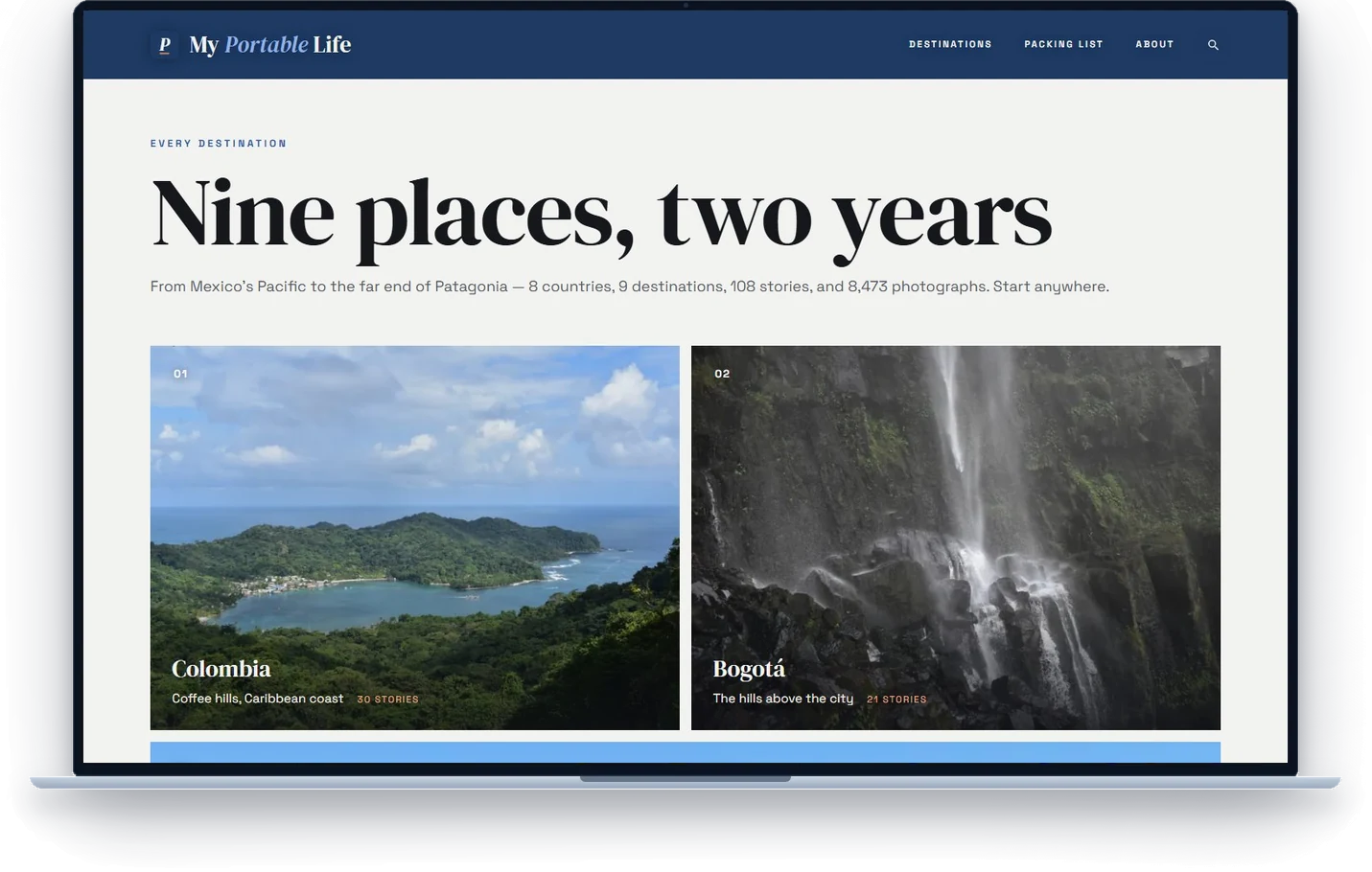
The home page: the journey from Argentina to Colombia and the places and stories since, led by photography.
Destinations
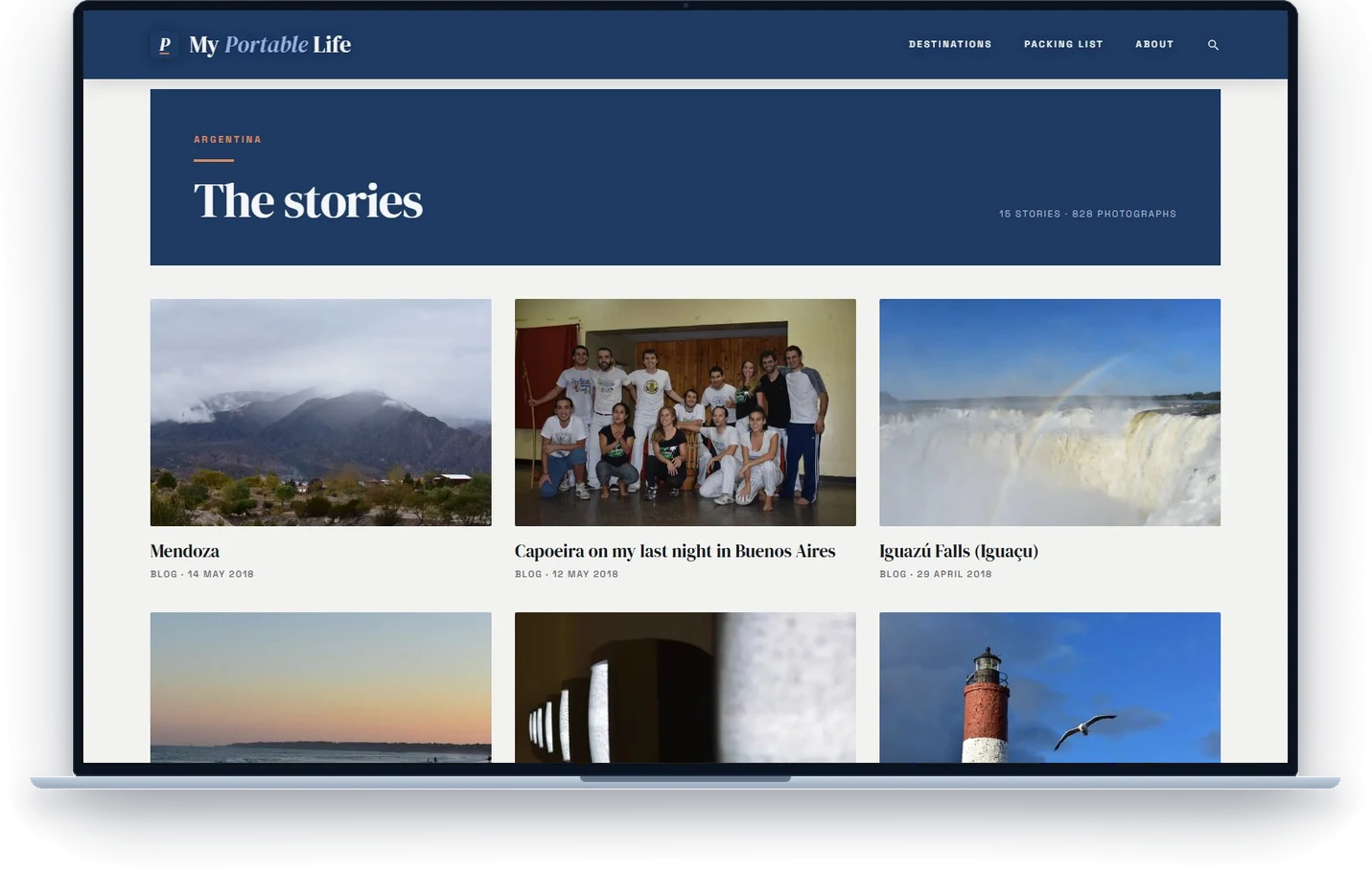
Every destination, with its number of stories and photographs.
A destination
A destination page gathers its stories and guides in one place.
Photo gallery
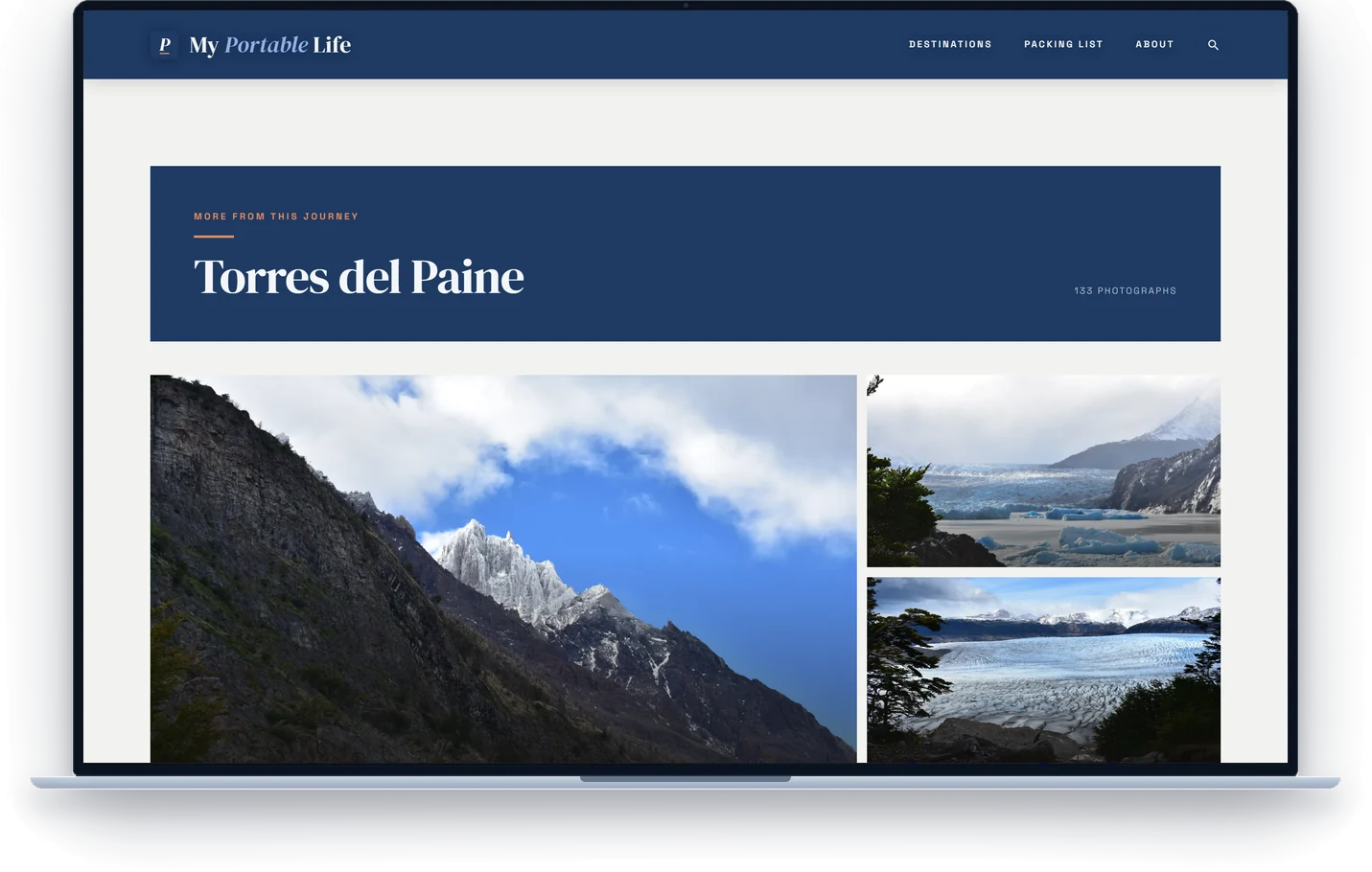
Each story ends with its photo gallery. This one, Torres del Paine, has 133 photographs.
Full size
Any photograph opens full size, and you can step through the rest of the gallery.
Packing list
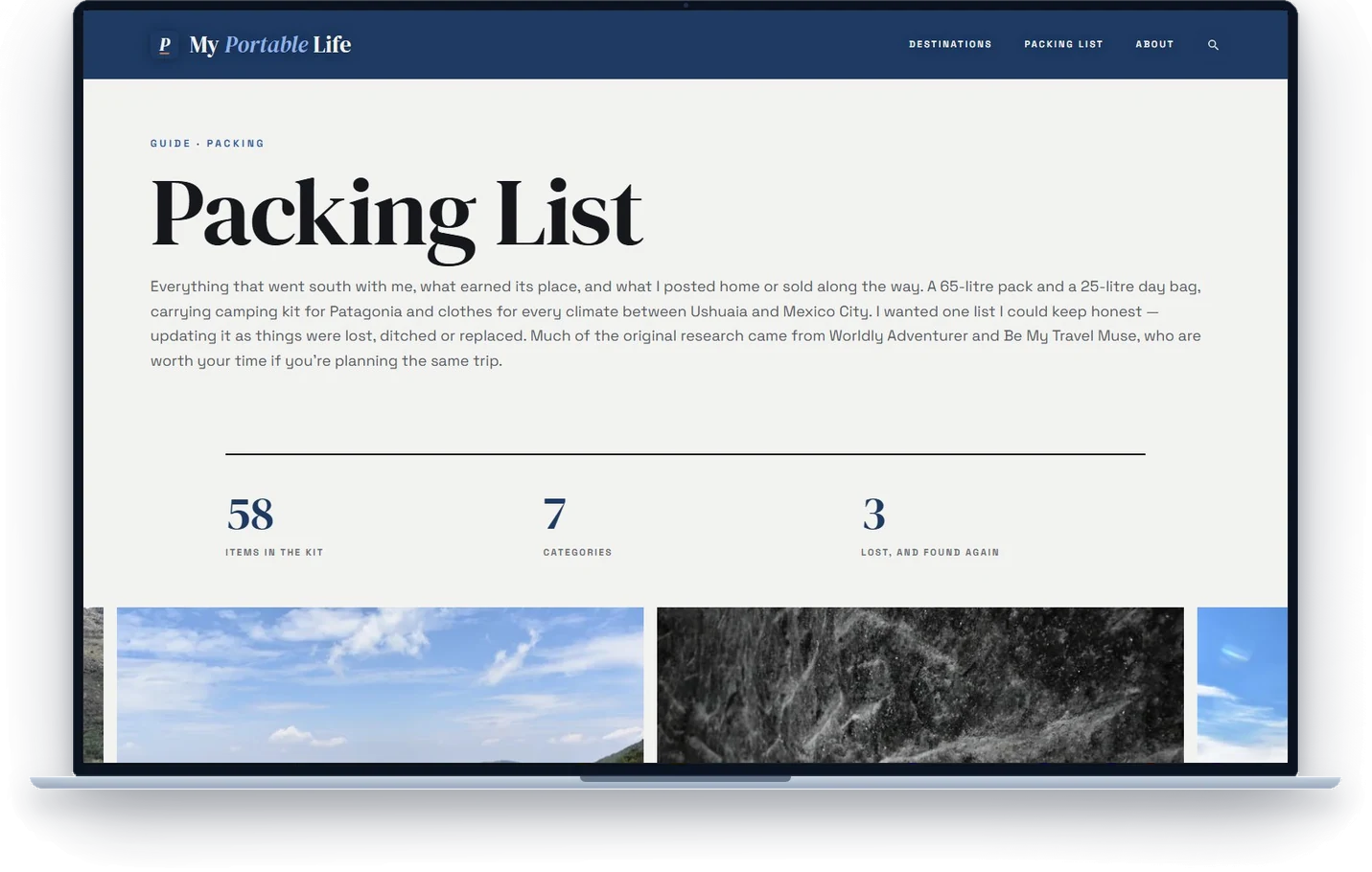
The packing list from the journey, with what was carried, what was replaced and what was lost.
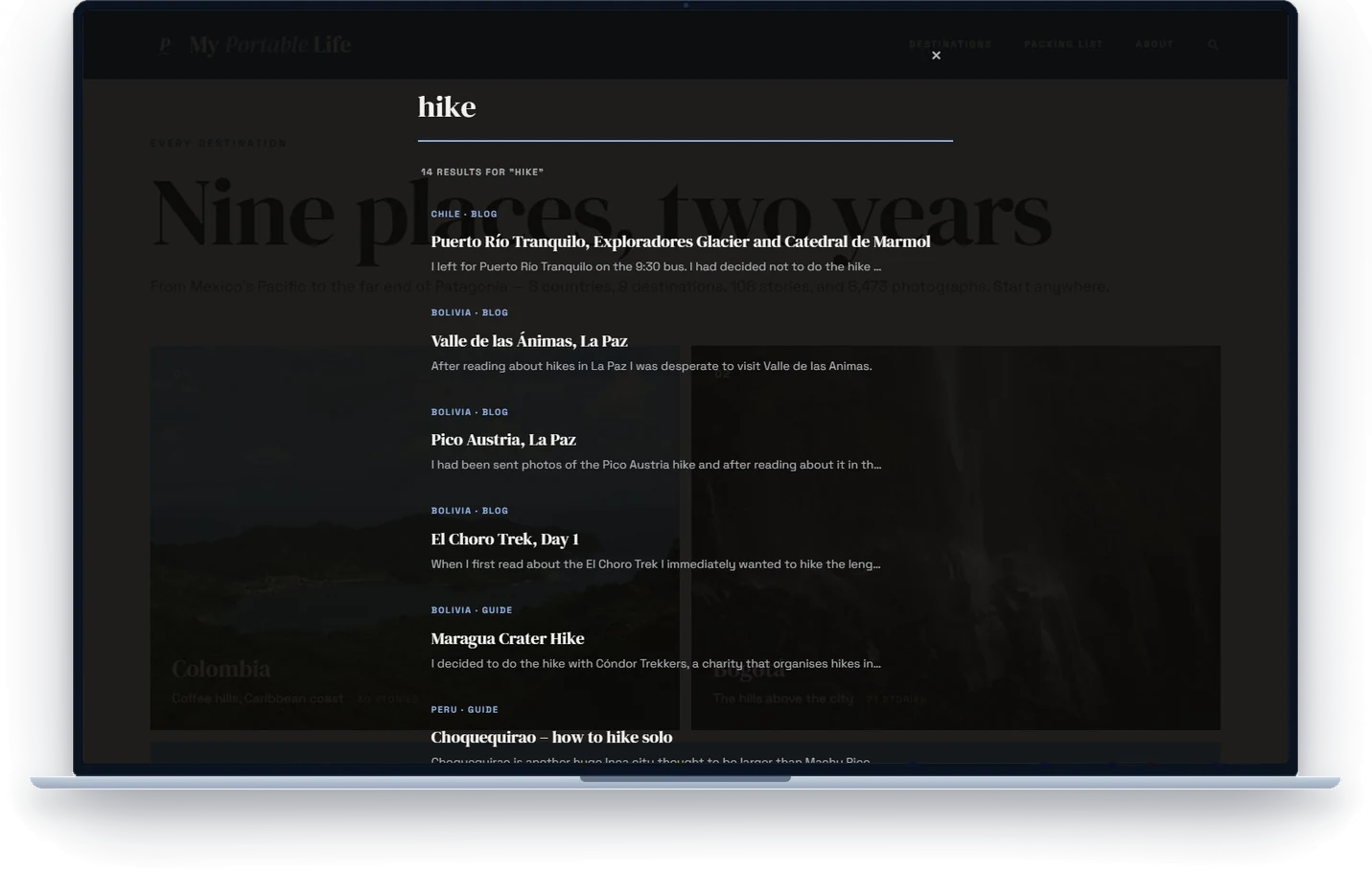
Search
Search finds stories and guides across the whole site.
On a phone
The site on a phone: the home page and a destination page.
Select a screen to enlarge it.
The story behind the project
The product
My Portable Life is the new home for my travel writing and photography. It started as a rescue project as a migration had broken most of the photos and my writing on a phone during my travels had never been reviewed, but it was also about finally moving forward with something I'd been meaning to do for years. I wanted a new site where I could keep writing, fill in the gaps from trips and hikes I'd never documented properly, and make use of the thousands of photographs I'd taken since the original blog.
The new design is much more focused on the photography, with destination pages, stories, practical hiking guides and galleries. It currently contains around 110 articles and guides, covering the original South American journey and places I've explored since. There's a search feature and a packing list, and the old site redirects readers to the corresponding pages on the new domain.
Behind the scenes it's no longer WordPress. Claude Code helped me build a static publishing system in Python, with the website hosted on Cloudflare Workers and the photographs on R2. That was a conscious decision to make the site simpler to maintain, rather than take on another WordPress installation.
Building it with AI
This was a longer project than some of my other AI builds. I started in 2025 by using ChatGPT to help tidy up the original articles, reviewing the rewrites myself and keeping both versions in Confluence. Recovering the copy was a substantial job, but it meant I finally had the writing in a state where I could build a new site around it. I'd recently launched Product Scope on WordPress, so my plan was to do the same here. I bought a theme and thought I could migrate the content and get the website online relatively quickly. Unfortunately the theme was far more complicated than I'd expected. What should have been the easy part became another project I couldn't find time to finish, even though I'd already done the work on the articles.
After rebuilding the Product Scope website with AI in summer 2026, I realised I could approach My Portable Life differently. I no longer needed to wrestle with a complicated WordPress theme, and what had previously stalled felt much more achievable. In July 2026 I started again with Claude Code, giving it the exported content from Confluence and working through how to turn that into a new website while keeping the old article addresses and the copy I'd already reviewed. I looked at several design directions before settling on a photo-journal style. I wanted the photography to do much more of the work than it had on the original site.
The photographs turned out to be the biggest job. I had more than 8,500 originals on an external drive, spread across trips and folders, while most of the old site's image links were broken. With Claude Code I built a process to prepare the photos in different sizes and formats, build the galleries and upload the files to Cloudflare R2. It also strips out metadata such as GPS coordinates before publication. That got the images working again, but it didn't mean I'd chosen the best photos for each article.
There was a fair amount of work involved in moving domains too. The old site still received around 500 visits a month, so I didn't want to lose readers who were finding the hiking guides through Google. I decided to retain the original article paths, redirect the old domain and test the redirects before considering the migration finished. I also changed the hosting plan partway through, moving from an initial Hostinger approach to Cloudflare.
One thing I haven't managed to automate away is the actual editorial judgement. I've got a staging tool for choosing hero images, marking favourites and flagging photos I don't want to use. But the decisions still need making, and I don't want AI inventing descriptions of places or photographs just to fill empty space.
Results and reflections
The main thing is that the website is back online. The old articles have a new home, the photographs work and visitors following links to Thirty Something Traveller can reach the corresponding stories on My Portable Life. After putting the job off for years, I finally have a site I can build on rather than one I keep meaning to repair.
It's far from finished. I've still got thousands of photographs to go through properly, some galleries and destination pages need another pass, and there's a growing list of trips and hikes I haven't written about at all. The number of pages and photographs means progress is still slower than I'd like, even with AI helping. But unlike the abandoned WordPress relaunch, it's now a working site I can improve gradually rather than another project waiting for me to find a free month.
For me this project has two stages, rescuing something I'd built years ago and then creating a place where I can keep writing. There are gaps in the original journey I still want to fill in, as well as trips and hikes from the years since that I've never written about. AI helped me recover the old material, rebuild the website and get past the technical work that had held everything up. The site is live again, but the writing and photography are an ongoing project, which was the point of bringing it back.
Continue exploring

Have an idea or a process you want working?
I take ideas from spec to a working product, and the same approach applies to automation and AI projects inside organisations.