Product Scope Website
Rebuilding my consultancy website as a lightweight, maintainable static site.
In July 2025 I finally launched the Product Scope website after spending months wrestling with WordPress, a theme built around Qi Blocks and responsive layouts that seemed to behave differently on every page. I'd put a lot of work into the content and design, so I had no plans to rebuild it again.
That changed when a client struggled to update the mobile layout of her own WordPress site. I used Claude Code to rebuild it in two days, keeping the existing content and design but removing the page builder. I was impressed enough with the result to repeat the process for Product Scope. The larger rebuild took about a week, and the static site replaced WordPress in July 2026.
Product screens and details

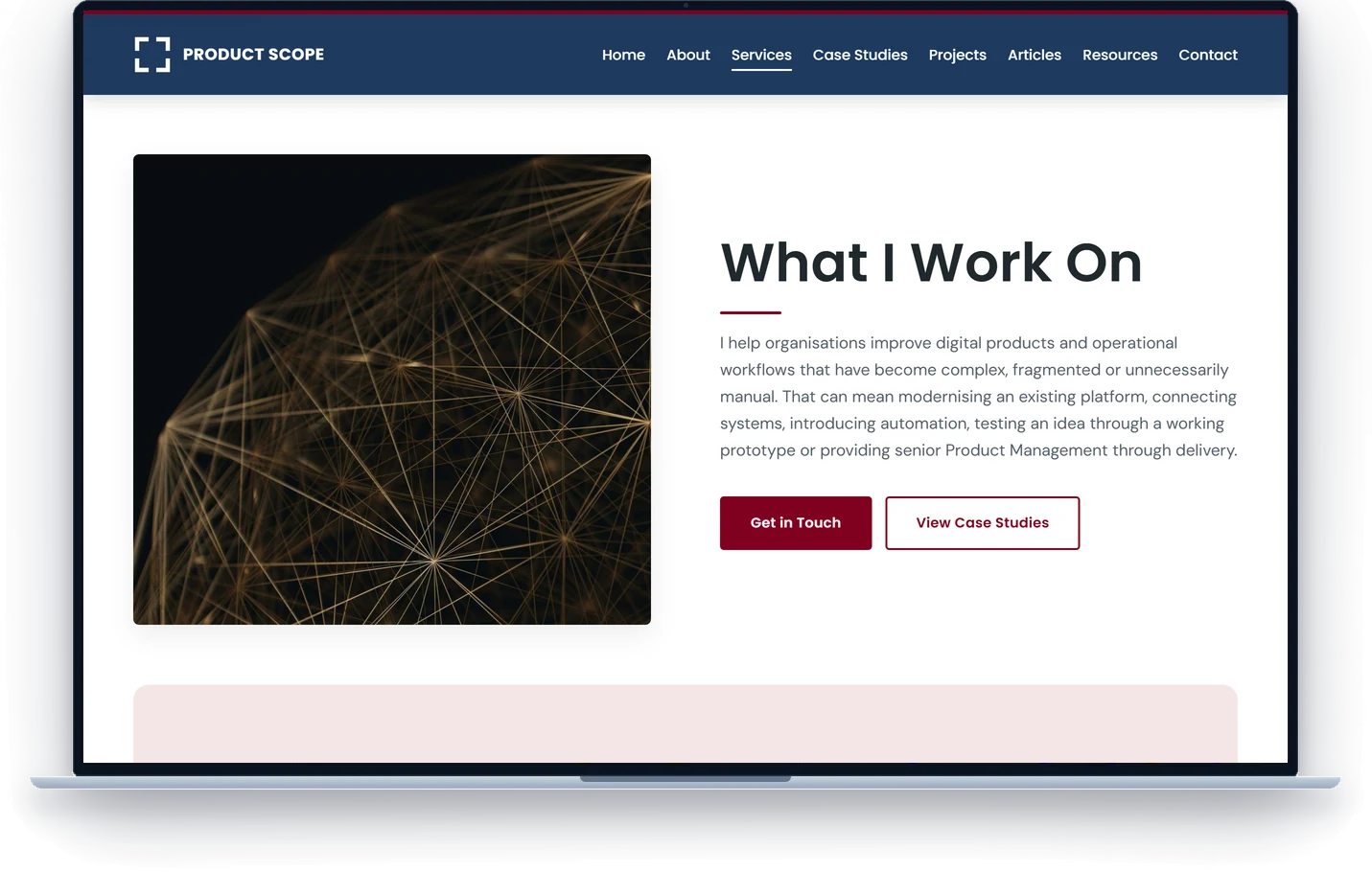
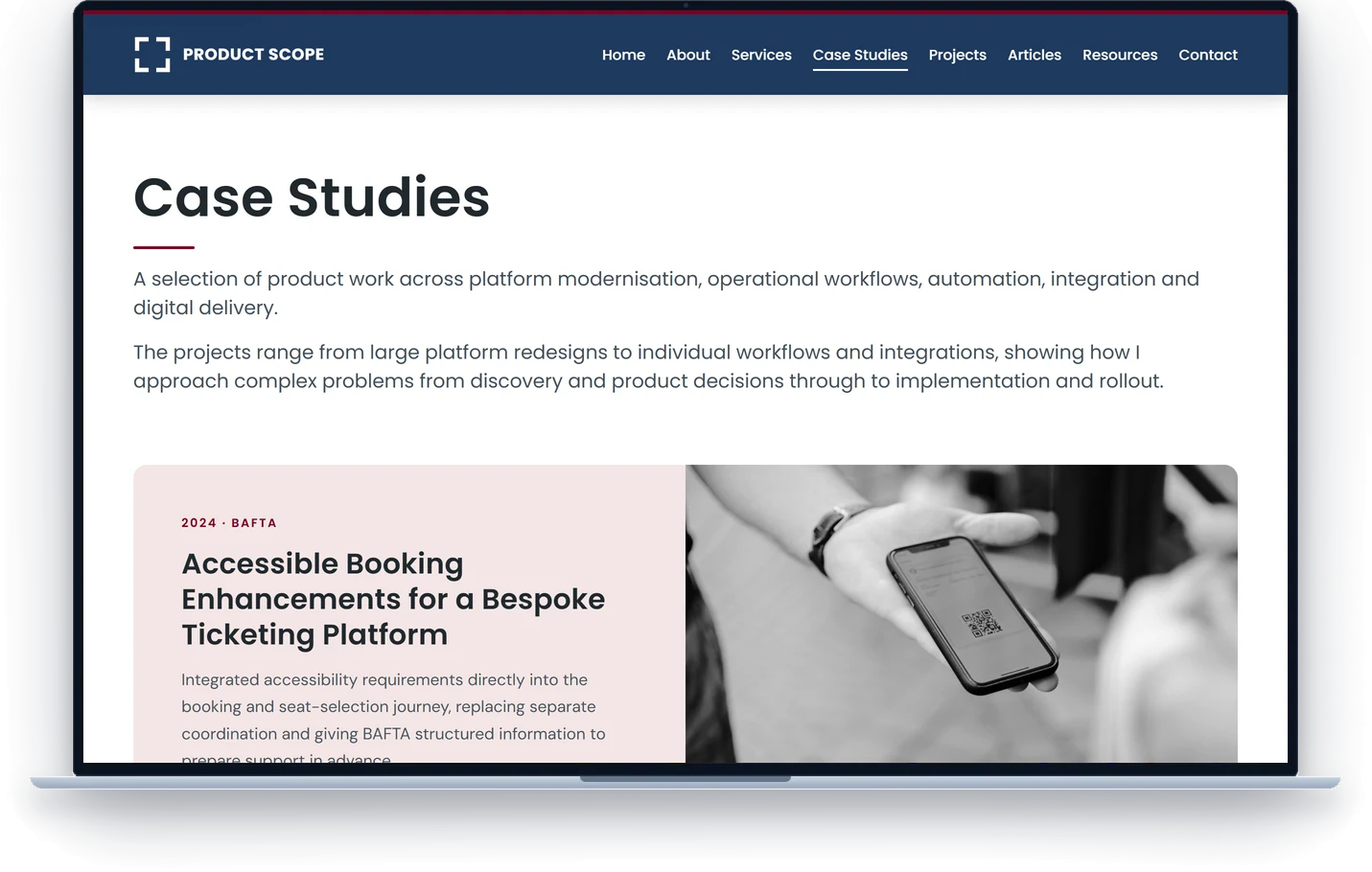
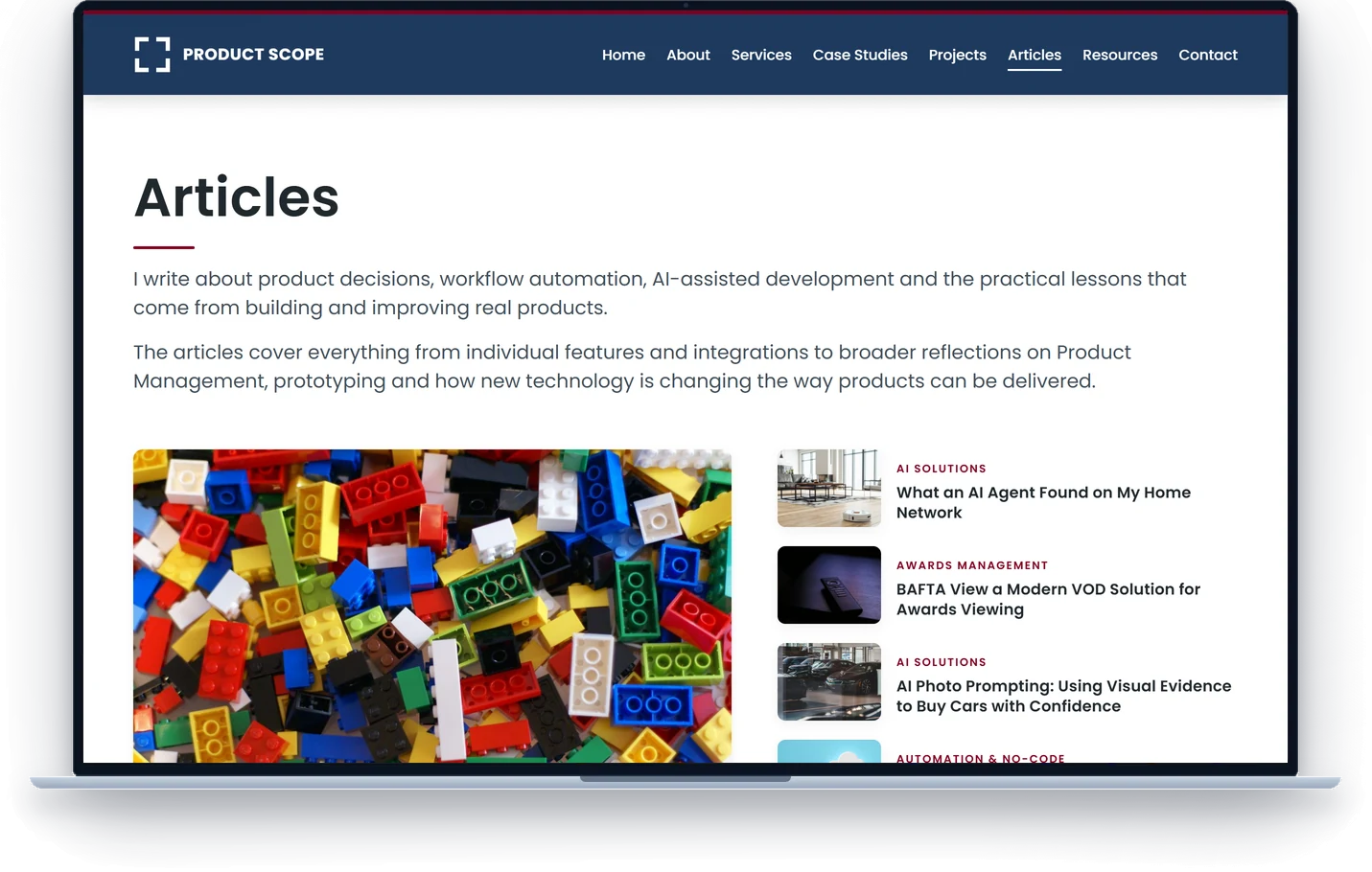
Home
The home page: what Product Scope does, with a clear way to get in touch.
Services
Services, written once and laid out with the same shared components as every other page.
Case studies
Case studies and project pages use the same layouts, so new pages do not introduce a different set of styles.
Articles
Articles, categories, related links and previous and next links are all generated from one manifest.
Select a screen to enlarge it.
The story behind the project
The product
The website you're reading contains my consultancy services, professional case studies, articles and independent projects. The pages are built with HTML, CSS and a small amount of JavaScript, with shared navigation, typography and layouts rather than separate WordPress blocks that have to be configured for each page. There is no public admin interface, theme, page builder or content database. Removing WordPress, its plugins and the public login also reduces the site's attack surface and the number of components requiring security updates, although the hosting, dependencies and contact form still need to be maintained securely. Publishing articles still needed more than individual HTML files. I use a shared manifest and Python scripts to generate the article index, categories, related articles, previous and next links, SEO metadata and sitemap. Articles can be prepared with a future publication date and appear when that date is reached, so I can schedule content without logging into a CMS.
The contact form runs through a Cloudflare Worker, with validation and spam protection before passing submissions to Make for the email workflow. Fonts are hosted locally and I replaced Google Analytics with Cloudflare Web Analytics. The code is stored in GitHub and deployed to Hostinger. Changes go to a staging website first, where I can check them before releasing to production. That gives me version history and a way to roll back changes, without editing the live website directly.
Building it with AI
I'd already spent months building the original Product Scope site in WordPress. The theme relied heavily on Qi Blocks, and I ended up making repeated CSS fixes when columns, spacing and images behaved differently on mobile. I eventually worked out how the example templates had been assembled and recreated the pages properly, but it was far more work than I'd expected from buying a theme.
The idea to rebuild came from a client who had spent half a day trying to fix a mobile layout. I asked Claude Code to inspect her existing website and document its pages, navigation, copy, imagery and reusable design patterns before writing code. Within an hour it had recreated most of the site locally. I compared the result with screenshots and worked through the missing content, spacing and responsive problems. The first version came quickly; getting the final details right took the rest of the two-day rebuild.
I then repeated the process for Product Scope. The site had considerably more content, including articles, case studies and different page types, so I spent about a week checking each page against the WordPress version. I wasn't looking for an exact copy. Some of the WordPress layouts had always felt clunky, particularly the spacing, alignment and how components adapted to smaller screens. Working with Claude Code gave me the opportunity to improve them rather than preserve those compromises. I challenged its initial choices when it introduced oversized headings, generic cards or decorative gradients, then iterated on the typography, spacing, images and mobile layouts until the design was more consistent. I documented the resulting design rules so new pages wouldn't introduce a different set of styles.
Once the pages were in place, I reviewed the website as a whole rather than treating each page as finished. I checked accessibility, security, performance and code quality, changed the analytics and font setup, and worked through the article publishing scripts. I put the code in GitHub and set up automatic deployment to staging with a separate production release. Claude Code handled much of the implementation, but I directed the changes, compared the output with what I wanted and decided what was ready to publish.
Results and reflections
The WordPress version took months to build. The static rebuild took about a week, retained the content and substantially improved the design, particularly where the original layouts had felt clunky. It also removed the WordPress theme, plugins, page builder and public admin login, reducing the maintenance overhead and exposure to vulnerabilities in those components. The earlier client rebuild took two days, so I'd applied the same approach to two working websites rather than just experimenting with a prototype.
Changes are also easier to manage. I can give Claude Code the content and an existing page as a reference, review the result on staging and release it when I'm happy. Previously, even an apparently simple WordPress change could mean adjusting several block settings and CSS overrides. I still have to check layouts and content carefully, but I'm spending more time reviewing the result and less time fighting the tools.
I wouldn't argue that every website should move away from WordPress. A large publishing team or a site with complex accounts and permissions may need a proper CMS. But for a consultancy site like this, the rebuild showed me that I could deliver and maintain a custom website without writing every line of code myself. It's also an approach I can offer to clients whose straightforward websites have become difficult to update.
Continue exploring
Interested in how I built it?
The full story covers the initial build, the problems I encountered and what I learnt.
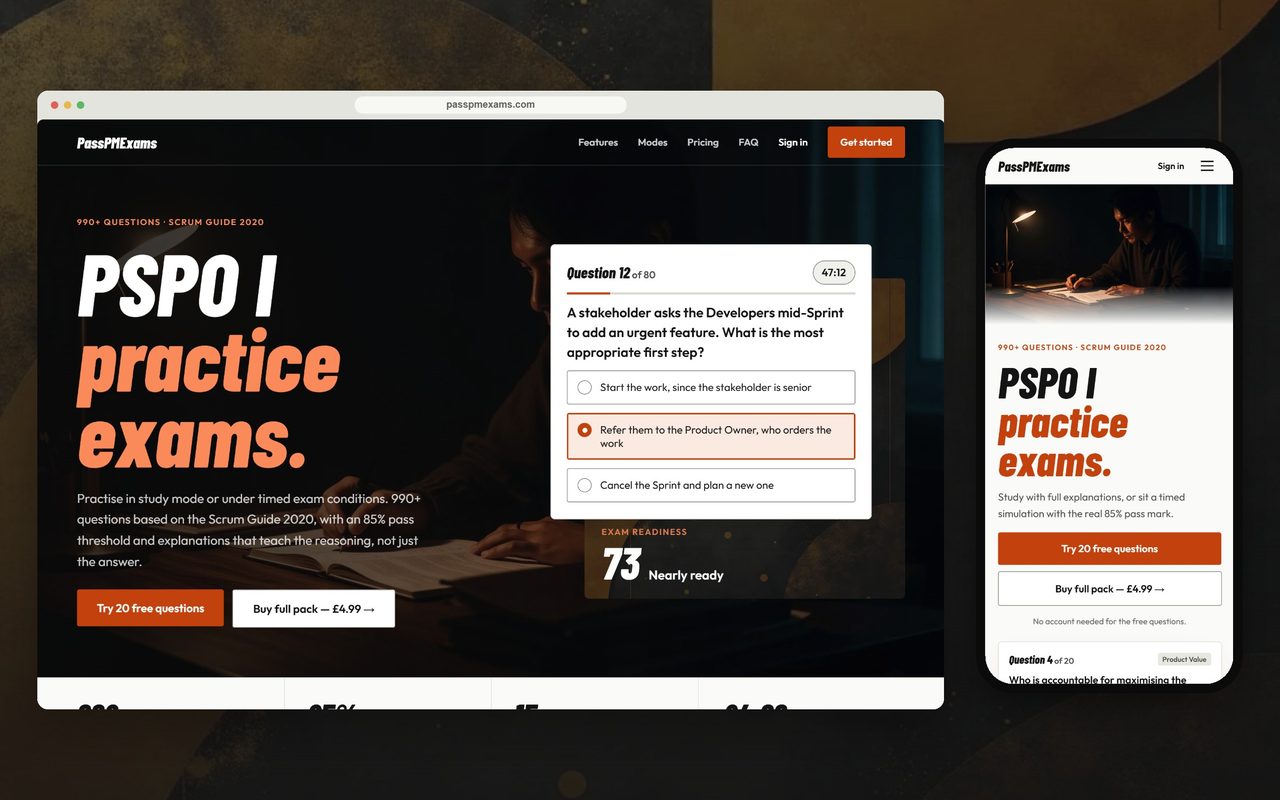

Have an idea or a process you want working?
I take ideas from spec to a working product, and the same approach applies to automation and AI projects inside organisations.