I started reading Fighting Fantasy books with my son and we got completely lost in a maze in the first book. I read that the recommended way to tackle these sections was to draw a map as you went along, but that sounded like a huge undertaking, especially when every wrong turn could send you back through parts of the book you'd already explored.
I wondered whether a simple application could keep track of the numbered sections we'd visited and draw the map for us, so we could concentrate on playing rather than filling pages with notes. The opportunity to try it came at a children's party in April 2026. My son was bored, I'd just seen that Claude Code could be used remotely from the Claude app, and I decided to see what I could build from my phone. It became my first Claude Code project.
Product screens and details

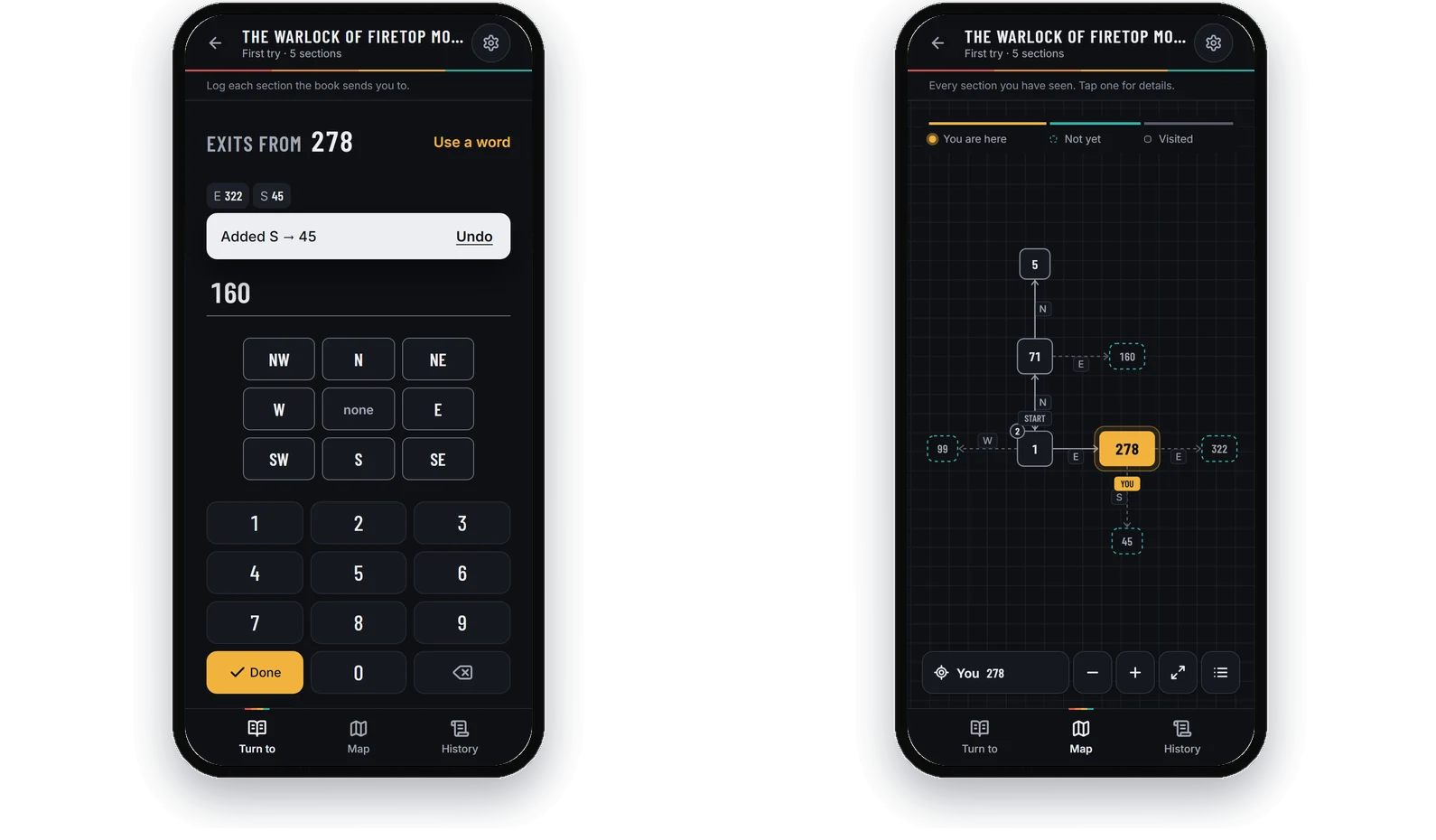

Start an attempt
Choose a book, then tap each numbered section the book sends you to.
Build the map
Record the exits you know about and the route map draws itself. Dashed boxes are sections you have not visited yet.
History
Every step of an attempt is kept, and earlier attempts are saved in your browser so you can pick one up again.
Select a screen to enlarge it. The route shown is sample data.
The story behind the project
The product
ReadRoute is a mobile-first website for Fighting Fantasy and other branching gamebooks. As you move between numbered paragraphs in a physical book, you enter the sections you've visited and, if useful, the choices and compass directions connecting them. The application builds a visual route map from the information you've recorded, rather than pretending to know the book's complete layout.
It also keeps the history of each attempt. You can see where you went, mark fights, items and dangerous sections, add notes or room names and revisit what happened on earlier attempts. That means a dead end isn't necessarily wasted effort because on the next playthrough, you can recognise a route you've already tried without the application revealing a walkthrough or telling you which choice is correct. The book picker includes Fighting Fantasy and Lone Wolf titles and you can add another book manually.
I designed it mobile-first because younger readers are more likely to have a phone to hand than to sit at a laptop while reading. It needed to work comfortably beside a physical book, with quick interactions and minimal typing. It's a React/Vite website with progressive web app features, hosted through Cloudflare, rather than a native mobile app. Reading progress stays in the browser, with no account or server database, and can be exported and restored using a JSON backup file. That keeps the infrastructure simple, but it also means usability, reliable saving and recovery matter. The aim is for recording a paragraph to take only a moment, rather than interrupt the story.
Building it with AI
ReadRoute was my first attempt to build an application with Claude Code, just as remote coding became available through the Claude app. I was at a children's party, had an idea I wanted to try and could start the build without sitting at my desk. I used ChatGPT and Claude to develop the initial product brief and began with a lightweight version that would let us enter paragraph numbers and record our route.
The first build was too focused on keeping a list of sections which didn't really work. I wanted a map that could help my son and I understand where we'd been in the maze. I went back to the design and added route visualisation and memory across attempts, while broadening the concept from Fighting Fantasy to other gamebooks. The trickier problem is that the map has to make sense from incomplete information. The reader might only know a few passages and directions, and a later discovery mustn't make the existing map misleading.
I've continued experimenting with the interface, using Claude Code to try different layouts, simplify the process of adding a section and improve the map. Some of the designs have looked promising, but the overall experience has never quite felt right to me. There have been several rounds of changes to navigation, controls, mobile behaviour and visual styling, and I've caught problems through reviewing the application rather than through full playtesting.
ReadRoute was also my first experiment with Cloudflare. I initially deployed it using Cloudflare Pages, which was a straightforward way to host a small static application without having to manage a server. More recently I moved it to a Cloudflare Worker serving the static assets, giving me experience with another part of the platform and its deployment workflow. I deliberately kept the application local-first, with no accounts or backend data store. Other recent work has concentrated on offline use, backup and recovery, making save failures visible and avoiding conflicting changes when several browser tabs are open. The repository includes automated tests and browser checks, but those don't replace trying the application properly with an actual book.
Results and reflections
ReadRoute is built and available online, but it hasn't progressed as far as I'd hoped. I've spent time improving the code, map and interface, yet I still haven't sat down with my son and completed a proper playthrough using it. Finding time to do that amongst everything else has been harder than finding time to ask Claude to build another feature.
That matters because the most important question remains unanswered: “does using ReadRoute make a Fighting Fantasy adventure easier and more enjoyable, or does recording every turn get in the way of reading?” I can test individual controls and check that the map draws correctly, but I won't know whether the product works as intended until we use it together, get lost, make mistakes and see whether the previous routes help.
It's also been a lesson in the limits of AI-assisted iteration. Claude Code has allowed me to try several different interfaces, but faster implementation hasn't automatically produced a design I'm happy with. The next step isn't more features or another redesign. It's finding the time for a real playtest and then deciding what, if anything, needs changing.
Continue exploring

Have an idea or a process you want working?
I take ideas from spec to a working product, and the same approach applies to automation and AI projects inside organisations.