

Improving Judge Creation in Nucleus
Improving Judge Creation in Nucleus
In the next few posts I’ll be looking back at some of the more impactful Nucleus features launched in 2025 post the Administration Re-design. In this post I look at how a support ticket from one of our clients crystallised a broader platform opportunity. They’d attempted bulk viewer creation and ended up with duplicates, missing assignments, and corrupted data forcing manual clean-up that took hours. This highlighted two systemic issues in Nucleus’s judge creation workflow that were creating unnecessary operational overhead.
The strategic opportunity
Unlike other user types in Nucleus, viewers accumulate errors over time without automatic cleanup. Admins have batch deletion tools, but inconsistent usage leads to compound data integrity issues—exactly the type of workflow problem that automation can solve.
The call with our client surfaced two core pain points. First, bulk viewer uploads lacked validation, allowing duplicates, incomplete datasets, and malformed emails to corrupt the system before anyone could intervene. Second, existing judges weren’t notified about new category assignments, creating coordination gaps that required manual intervention.
Both issues were forcing admins to either chase judges to fix mistakes or leave judges confused about their responsibilities.
The judge creation solution
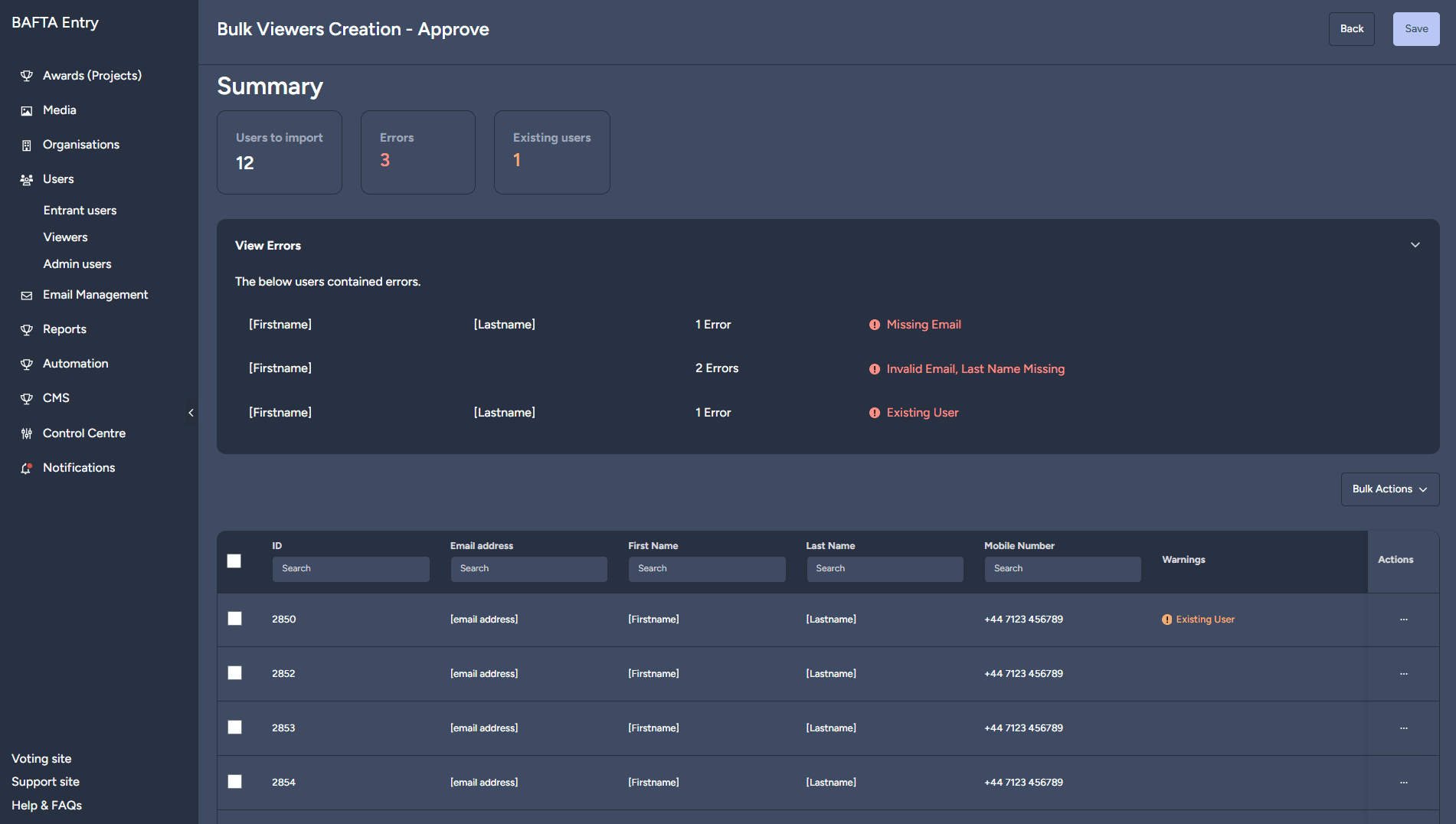
The admin redesign had given me more flexibility with validation flows, so I identified that validation needed to happen before creation, not after damage was done. This required adding a review step to the bulk creation process—ordinarily counterproductive as most improvements reduce steps, but strategic here to prevent downstream operational costs.
Working with the designer, we created a clear validation interface that flags existing users, duplicate entries, incomplete data like missing email addresses or categories, and broken data like malformed emails or invalid references. I mapped out explicit error messages and workflows with the developers, giving admins confidence that intended viewers would be created correctly.
I also identified an opportunity to improve communication by creating a new email template specifically for existing users. Previously, all bulk creation emails used the same template, which made no sense when contacting someone familiar with the platform versus someone completely new. The new system allows admins to customise messaging appropriately for each group.
We added conditional UI that only appears when relevant—if the upload contains only new viewers, the existing user messaging option doesn’t show. This keeps the interface clean whilst ensuring admins don’t waste time configuring messaging that won’t be used.
Measurable impact
The result is a more reliable workflow that’s eliminated two separate failure points where admins struggled to effectively communicate with judges. Support tickets related to viewer creation dropped by approximately 60%, and client feedback indicates the process now feels predictable and trustworthy.
It’s a relatively focused improvement, but it demonstrates how strategic validation can transform unreliable manual processes into confident, automated workflows. This type of incremental platform evolution is exactly what cultural organisations and broadcasters need—sustainable improvements that compound over time whilst maintaining system stability.
The work has also laid technical groundwork for the broader judging interface improvements planned for 2026, establishing patterns for data validation and user communication that can be applied across other platform areas.